
Shifting Funds from the Police to the People
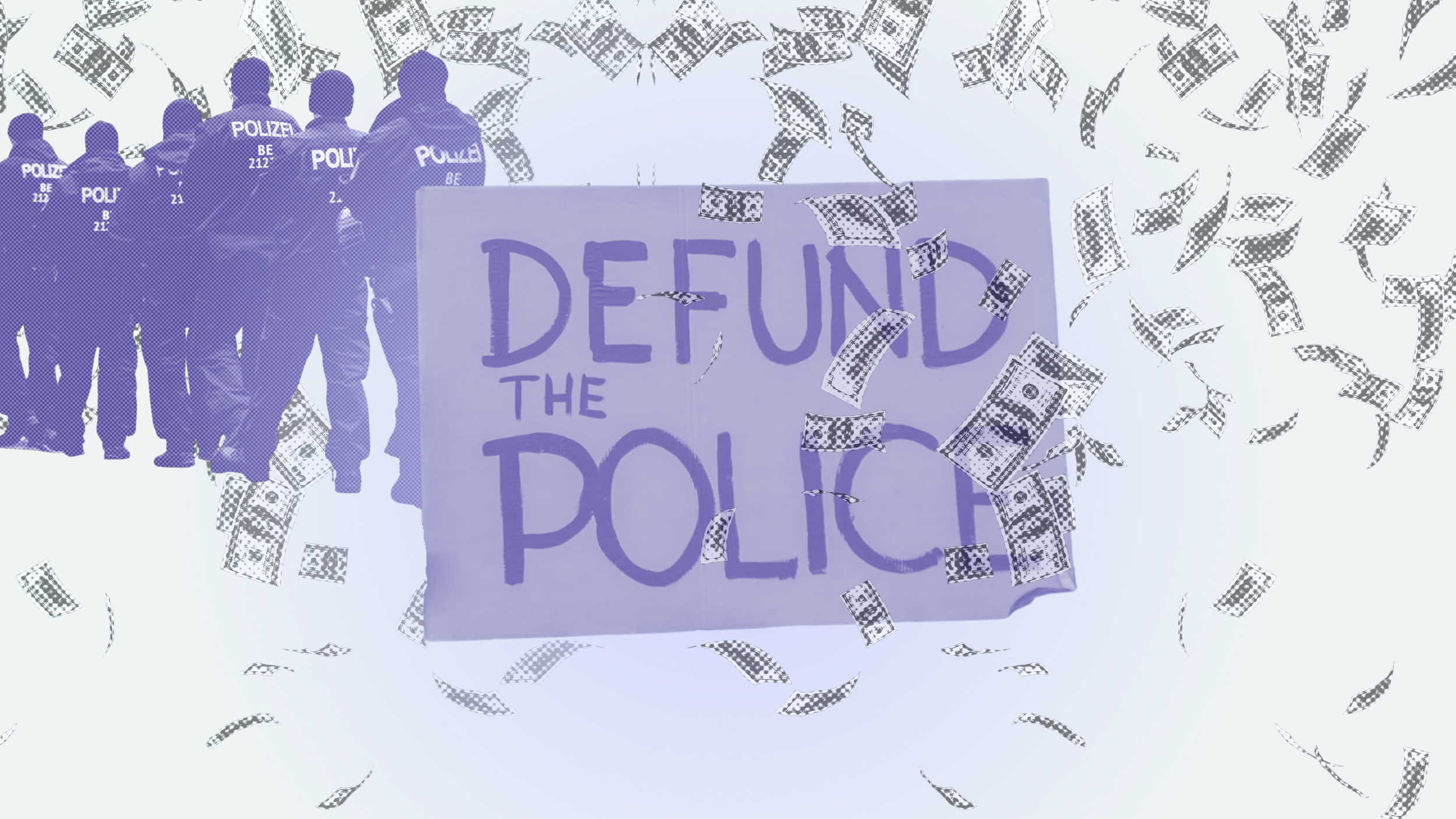
In December 2025, Justice Collective released a new report arguing that we should reinvest Berlin's police budget resources into communities.
With every new budget planning period, Berlin politicians tell us there is not enough money to fund all the things that make life in the city worth living. Over the last years, coalitions have formed across the social sector, cultural sector, education sector and beyond to organize opposition against austerity measures that appear to be increasingly inescapable. Even as overall spending is set to reach new heights in the upcoming budget period, many still face significant cuts, as we detail below.
Yet, one agency consistently escapes austerity measures: the police. Berlin’s police budget has steadily increased over the last years, growing from just under €1.2 billion in 2010 to over €2 billion in 2024 – a 65% increase that outpaces inflation. To put this enormous amount of money into perspective: The police’s budget is larger than the entire budget for Labor, Social Affairs, Equality, Integration, Diversity, and Anti-Discrimination (Arbeit, Soziales, Gleichstellung, Integration, Vielfalt und Antidiskriminierung), and more than twice the size of the budget for Culture and Social Cohesion (Kultur und Gesellschaftlicher Zusammenhalt). This outsized spending must be stopped and rolled back in order for the people of Berlin to thrive.
This report compiles information on police spending in Berlin that is generally not available in one place, since this information is often spread across different budget documents that are difficult to navigate. In addition, we situate these numbers in the context of ongoing police activity in Germany’s capital, in an attempt to make clear what is at stake. We argue that money spent on policing in Berlin is not for the good of local communities but rather at their expense – and that this is especially true for Berlin’s marginalized, racialized, and migrantized communities. Further, we assert that Berlin needs to shift its budget priorities in accordance with a substantive understanding of safety, which does not conflate policing with what makes us safe. Rather than turning to police, we should instead turn towards redistributing wealth, improving living conditions and access to healthcare, and to other resources that enable people to live a dignified life in this city and beyond.
Our argument unfolds across three sections in this report:
In Section 1, we examine what Berlin’s police budget looks like in detail and what this money is being spent on. Our key findings show that Berlin spends exorbitant amounts on policing year after year, with spending continuing to rise regardless of the governing coalition in power. As we show, the vast majority of spending is for personnel, totalling €1.57 billion in 2024. From 2013-2023, the Berlin police have added over 15% to their work force, measured in full-time staff working hours (full-time equivalents, FTE). While the police department has gotten bigger, other departments have seen decreased staffing over the same period, including social services, family assistance, child and youth welfare services, and hospitals. The number of police and police support staff is at approximately 26,500 FTE in 2024. This means that at 723 staff per 100,000 residents, Berlin has more police personnel per capita than New York City (556 per 100,000 residents).
Spending on police equipment has also increased significantly: In 2024, Berlin spent just over €400 million on equipment, an increase of 36.59% from 2010. As we detail, this equipment includes tasers, body cameras, and surveillance technologies, all of which grant more power to the police in everyday encounters, exposing the people of Berlin to potential violence.
In Section 2, we shed light on some of the social and political dynamics that facilitate this vast amount of police spending as well as some of the impacts this has on racialized and marginalized communities in particular. In recent years, Berlin has allocated funds for expanded police presence in migrantized neighborhoods, including for the construction of new police stations, to fund special task forces, and to build out surveillance infrastructure. This has been at the expense of solutions that actually address challenges Berlin’s communities face: While police spending continues to rise, measures and programs that address harm directly fall victim to budget cuts, severely affecting vulnerable and marginalized communities in the city.
What’s more, the policing of migrantized neighborhoods and racialized communities is a form of racist violence. For decades, hotspot policing focusing on so-called “crime hotspots” (kriminalitätsbelastete Orte, kbOs) has allowed police to carry out suspicionless searches in certain areas, giving legal cover to racial profiling. Recent proposed changes to the Berlin police law (ASOG) call for video surveillance at kbOs and the deployment of artificial intelligence to analyze video recordings – both projects that cost money. In July, the city designated additional locations – and the entire subway system – as weapons prohibition zones (Waffenverbotszonen), marking more places for increased policing capacity. For many years, and especially since October 2023, Berlin has also expended considerable resources to police demonstrations in solidarity with Palestine. Human rights groups, investigative reporting, and video footage by activists have repeatedly shown that this policing has been marked by widespread violence.
These developments are fuelled and legitimized by ever-new waves of moral panics, in which racist narratives linking migration to crime and disorder drive demands for more and more policing, specifically against migrantized groups. The section outlines our understanding of the moral panic concept and discusses three concrete examples of how real or perceived crises factor into increasing police budgets: policing hotspots, policing the housing crisis, and policing so-called “crime trends”. In each case, media and political narratives have called for additional police spending and legitimized violent police activity, driving police spending.
In Section 3, we detail our demands for the immediate defunding of police and simultaneous investment in local communities and what makes them safe. We propose concrete, realistic measures such as reducing Berlin’s police force per capita to less than New York City’s, not hiring additional police, abolishing overtime compensation for police, and defunding police technology and hotspot policing that could free up more than €500 million annually.
Instead of spending money on police, we urge the government to invest in making people’s lives better, tackling the root causes of harm, and to support alternatives to punishment as means of addressing harm. Four specific interventions we highlight are alternatives to police response, harm reduction, housing, and anti-violence work. While acknowledging that existing models and approaches are often caught in the punitive logics and practices we are trying to challenge, we take these and similar models and approaches as ones to build on and continue to critically interrogate through experiments that center local communities and their well-being. As abolitionists, we work toward a world without policing – a world where we respond to harm through care rather than punishment. These demands are concrete steps we can take now to move in that direction.